Okay, here is the brief note of what's happening on my blog.
Giveaway:
Fractured Light
The New Death and Others
Book Tour
Emerald City Virtual Book Tour
Interviews
James Hutchings
Guest Post
James Hutchings on Creative Commons
Review
Another Jekyll, Another Hyde
New Girl
Fractured Light

Showing posts with label Guest Post. Show all posts
Showing posts with label Guest Post. Show all posts
Thursday, February 2, 2012


Guest Post + The New Death and Others Giveaway
Author James Hutchings has been kind enough to offer a giveaway, guest post and author interview(read the interview here) for me. (Rafflecopter signup for giveaway is at the bottom of this post)
Guest Post
Many writers, whether
published or just starting out, are very nervous that someone else will steal
their work, whether that be another writer using their ideas in their own
stories, or someone making pirated copies of their books. When I put out a
collection of my writing, I specifically gave permission for anyone at all to
copy my ideas, or even to cut and paste whole stories. I also contacted the
Pirate Party, a worldwide network that wants to lessen copyright, and told them
that I was giving anyone permission to put my ebook on file-sharing sites. In
this post I hope to show why I went against common wisdom.
Creative Commons
I used a free service called Creative Commons. Creative Commons
is useful for people who want to give the general public permission to use
their work, but with restrictions. In my case I didn't mind people using my
work for non-profit purposes, such as posting on a blog, but I didn't want to
allow anyone to make money off it. Similarly I wanted anyone who used it to
give me credit. I could have just listed these things myself. However I'm not a
lawyer, and perhaps I would have worded it wrong so that someone could twist
what I said to do more than I meant. Also I could have been unclear about what
I was allowing and what I wasn't allowing. Sure, someone could email me and
ask, but the whole purpose of having a written statement is so that people
don't have to ask.
Creative Commons has a series
of different licenses, which give permission to do different things. They're
all legally 'tight', and they're all summarized in plain language. So all you
have to do is go to their site and answer a series of questions, to get to the
license that does what you want. In my case I used the Attribution Non-Commercial
License.
Why?
That's what I did. But why?
Common sense would suggest that I'm giving something away for free that I could
be selling. However I believe that, in the long run, I'll be better off. The
main reason is that I've seen how many people are, like me, trying to get their
writing out there. Go to Smashwords and have a look at the latest ebooks. Then
refresh the page ten minutes later, and you'll probably see a whole new lot.
The problem that new writers face isn't that people want to steal your work;
it's getting anyone to show an interest in your work at all. If someone passes
on a pirated copy of my work, it might get to someone who's prepared to buy it
- and that someone would probably have never heard of me otherwise. Even if
they don't want to pay for what they read, I might come out with something else
in the future, and perhaps paying 99c for it will be easier than hunting it
down on a file-sharing site.
Science fiction writer Andrew
Burt tells the story of someone who disliked his book, and to get back at him
decided to put a copy on a file-sharing site. The effect was that he got a
small 'spike' in sales immediately afterwards.
I also have some less selfish
motives. Many people would assume that the purpose of copyright is to protect
authors and creators. Leaving aside the fact that someone else often ends up
with the rights (how many Disney shareholders created any of the Disney
characters? How many shareholders in Microsoft have ever written a line of
code?), that doesn't seem to have been the intention in the past. The US
Constitution says that Congress has the power "to promote the Progress of
Science and useful Arts, by securing for limited Times to Authors and Inventors
the exclusive Right to their respective Writings and Discoveries." Note
that protecting 'intellectual property' isn't mentioned. The authors of the
Constitution seemed to see the point as getting ideas out there where people
can use them: almost the exact opposite of keeping them 'safe' and 'protected'.
The original idea of
copyright seems to have been a sort of deal: you have an idea, and we want you
to get it out into the world where it will do some good. To encourage you to do
that, we'll give you a monopoly on its use for a limited time. After that,
anybody can use it (it will enter the 'public domain').
A lot of people don't know
that copyright used to give a lot less protection than it does now, especially
in the United States.
In the US,
it used to be that works were copyrighted for a maximum of 56 years. Today
copyright in the US
can last for over 100 years. In fact Congress keeps extending the time. In
practice, they're acting as if they never want ideas to go into the public
domain.
This is great for the owners
of 'intellectual property'. But it's hard to see how this "promotes the
Progress of Science and useful Arts," or how forever is a "limited
time." In a sense it's a theft from the public. Anyone who publishes work
has accepted the deal that the law offers, of a limited monopoly in return for
making their idea known. Congress has been giving them more and more extensions
on that monopoly, but doesn't require them to do anything to earn it.
It probably doesn't matter
that much that Disney still owns Mickey Mouse, or that Lord of the Rings is still under copyright. But remember that these
laws don't just apply to the arts. Similar laws apply to science as well. So a
life-saving invention could be going unused, because its owner wants too much
money for it, or because it's tied up in court while two companies fight about
who owns it.
Conclusion
I'm far from an expert on
either the law or the publishing industry. However I hope that I've given you,
especially those of you who might be thinking about publishing some writing, a
different take on the whole issue of whether authors should worry about their
ideas being stolen. At least I hope I've shown you that there's a different way
of thinking about it, and that that way doesn't require you to just give up on
making money; in fact that it might be more profitable as well as better for
society.
---
bio: James Hutchings lives in
Melbourne, Australia. He fights crime as
Poetic Justice, but his day job is acting. You might know him by his stage-name
'Brad Pitt.' He specializes in short fantasy fiction. His work has appeared in
Daily Science Fiction, fiction365 and Enchanted Conversation among other
markets. His ebook collection The New
Death and others is now available from Amazon, Smashwords and Barnes
& Noble. He blogs daily at Teleleli.
---
This article is licensed
under a Creative
Commons Attribution Non-Commercial License.
 Death gets a roommate...
An electronic Pope faces a difficult theological question...
A wicked vizier makes a terrible bargain...
44 stories. 19 poems. No sparkly vampires. There's a thin line between genius and insanity, and James Hutchings has just crossed it - but from which direction?
---
Here's the giveaway!
a Rafflecopter giveaway
Saturday, May 14, 2011
Guest Post - Holly Schindler
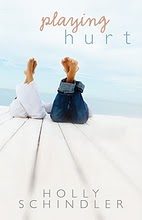
Hi! Holly Schindler is a award winning author (she'd just won a Gold Medal in the IPPY Awards for her debut novel, A BLUE SO DARK) having two novels under her belt. The two novels have gorgeous covers :

I'm thrilled to host a guest post for Miss Holly. Now, here are the her views on The Classics
The Classics

A BLUE SO DARK PLAYING HURT
I'm thrilled to host a guest post for Miss Holly. Now, here are the her views on The Classics
________________________________________________________________________
The Classics
Guest Post by Holly Schindler
I’m an old literature major. I could still recite the first half of THE LOVE SONG OF J. ALFRED PRUFROCK from memory (used to know the whole thing), and can also recite a good deal of Dickinson, Anne Bradstreet…Passages from JANE EYRE, PRIDE AND PREJUDICE…
I know that a lot of readers who far prefer contemporary fiction think this is a bit of a throwaway ability…kind of like knowing a bunch of useless trivia…
Actually, though, it’s not…
I don’t really think that an author’s voice is something that a writer’s born with…It’s something that develops over time. And part of that development is being exposed to as many other voices as possible…
Sure, you need to be familiar with the current works in the genre you want to write for…But your voice, the thing that makes you, well, you, is something that can be deepened, enriched by writers from other genres and other time periods…
Writers of classic literature have different voices, in part, because their worlds were different. Their realm of experiences were different (Jane Austen certainly never relied on a phone or rode in a car…) And if you can find a way to identify with those voices, if you can feel for characters from another time-frame, whose lives are so incredibly different from your own, the easier time you’ll have empathizing with the characters you create—and by expressing your empathy in your work, you will bring about an emotional response from your reader, as well…
_________________________________________________________
Facts On Miss Schindler :
1. Holly has a blog at hollyschindler.blogspot.com
2. She welcomes you to follow her on Twitter : @holly_schindler
3. Her other blogs : YA Outside the Lines and Smack Dab in the Middle
4. Remember to check out her books :
A BLUE SO DARK
Fifteen-year-old Aura Ambrose has been hiding a secret. Her mother, a talented artist and art teacher, is slowly being consumed by schizophrenia, and Aura has been her sole caretaker ever since Aura’s dad left them. Convinced that “creative” equals crazy, Aura shuns her own artistic talent. But as her mother sinks deeper into the darkness of mental illness, the hunger for a creative outlet draws Aura toward the depths of her imagination. Just as desperation threatens to swallow her whole, Aura discovers that art, love, and family are profoundly linked—and together may offer an escape from her fears.
PLAYING HURT
Star basketball player Chelsea “Nitro” Keyes had the promise of a full ride to college—and everyone’s admiration in her hometown. But everything changed senior year, when she took a horrible fall during a game. Now a metal plate holds her together and she feels like a stranger in her own family.
As a graduation present, Chelsea’s dad springs for a three-week summer “boot camp” program at a northern Minnesota lake resort. There, she’s immediately drawn to her trainer, Clint, a nineteen-year-old ex-hockey player who’s haunted by his own traumatic past. As they grow close, Chelsea is torn between her feelings for Clint and her loyalty to her devoted boyfriend back home. Will an unexpected romance just end up causing Chelsea and Clint more pain—or finally heal their heartbreak?
Miss Holly posing for the camera
Subscribe to:
Posts (Atom)
